IPLab:Lab 7:Fibroadenoma: Difference between revisions
Jump to navigation
Jump to search
Seung Park (talk | contribs) |
Seung Park (talk | contribs) |
||
| Line 28: | Line 28: | ||
=== Images === | === Images === | ||
* [ | * [{{SERVER}}/library/index.php?/tags/2147-fibroadenoma PEIR Digital Library: Fibroadenoma Images] | ||
== Related IPLab Cases == | == Related IPLab Cases == | ||
Revision as of 20:37, 29 August 2013
Clinical Summary
Four months prior to admission, this 25-year-old female became aware of a lump beneath the areola of her right breast. Physical examination confirmed the presence of an approximately 3 cm movable, rubbery mass. An aspiration was attempted but did not yield any fluid or cells. At the time of surgical exploration, a well-circumscribed mass was identified and removed.
Images
-
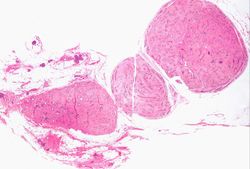 This low-power photomicrograph of the surgical specimen demonstrates three ovoid, well-circumscribed nodules surrounded by fibroadipose tissue.
 -
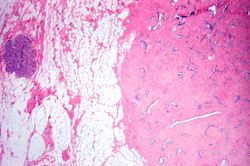 This is a higher magnification of one of the three nodules. At this power, the nodule seems to be composed of a solid parenchyma with small glandular spaces. The adjacent breast parenchyma consists mostly of fat.
 -
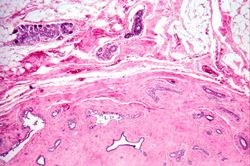 This is a higher magnification of the fibroadenoma showing the dense stroma of the tumor surrounding the irregularly shaped ducts. The adjacent fibrofatty tissue containing breast ducts and lobules has been compressed by the tumor.
 -
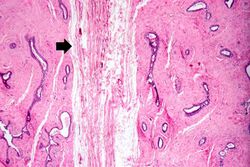 This photomicrograph shows the compressed connective tissue (arrow) between two nodules of dense fibrous tissue and ducts.
 -
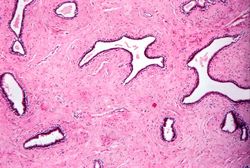 This is a higher-power photomicrograph of fibroadenoma showing ducts embedded in connective tissue.
 -
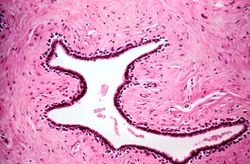 This is a high magnification of the fibroadenoma showing the dense stroma of the tumor surrounding the irregularly shaped duct. The ducts are lined by two cell layers, one of cuboidal, two columnar cells (inner layer) and an outer layer of flattened cells with hyperchromatic nuclei (myoepithelial cells).
 -
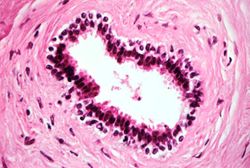 This is a higher magnification of fibroadenoma showing irregularly shaped ducts lined by two layers of cells as previously described.


Study Questions
Additional Resources
Reference
Journal Articles
- Yilmaz E, Sal S, Lebe B. Differentiation of phyllodes tumors versus fibroadenomas. Acta Radiol 2002 Jan;43(1):34-9.
- Hogge JP, De Paredes ES, Magnant CM, Lage J. Imaging and management of breast masses during pregnancy and lactation. Breast J 1999 Jul;5(4):272-283.