IPLab:Lab 6:Acute Rejection
Clinical Summary
This 34-year-old male with end-stage chronic glomerulonephritis had been receiving hemodialysis for 4 months when he received a living related-donor transplantation from his mother. The transplant was successfully with no complications. However, eight days later, transplant rejection necessitated removal of the transplanted kidney. After the nephrectomy, the patient did well and was returned to hemodialysis.
The rejected kidney was edematous and the pale tan-brown cortex was irregularly red-mottled. Upon sectioning the corticomedullary junction was not well-demarcated. The renal papillae were edematous and the renal pelvis had generalized petechial hemorrhages which extended through the 7-cm segment of ureter to a diffusely hemorrhagic terminal portion.
Images
-
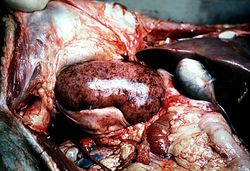 This is a gross photograph of a kidney with acute rejection from an autopsy case. Note that the kidney is swollen (edema and inflammation) and there are areas of hemorrhage throughout the kidney.
 -
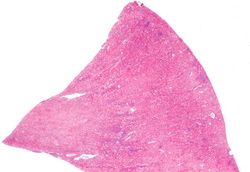 This is a low-power photomicrograph of the kidney that was removed from this patient. Even at this low power you can appreciate the focal accumulations of cells within this section and the diffuse cellular infiltrate (blue dots) throughout the kidney parenchyma.
 -
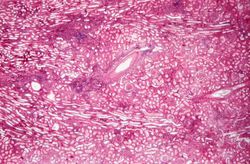 This is a higher-power photomicrograph demonstrating the cellular infiltrates within this kidney section. Note that in addition to the diffuse cellularity, the focal accumulations of cells appear to be focused around blood vessels.
 -
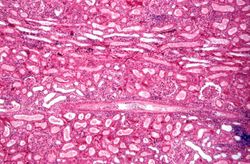 This is a higher-power photomicrograph demonstrating the cellular infiltrate within the interstitium and around the small blood vessel in the center of the image.
 -
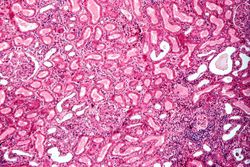 This is a higher-power photomicrograph demonstrating the cellular infiltrate within the interstitium. There is some degeneration (coagulative necrosis) of tubules and glomeruli.
 -
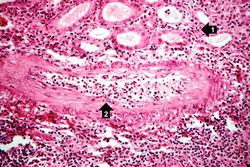 This high-power photomicrograph demonstrates the cellular infiltrate within the interstitium (1) and in the wall of the blood vessel (2).
 -
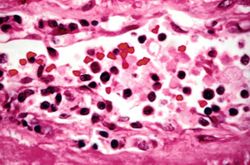 This is a high-power photomicrograph of cells infiltrating the wall of the blood vessel.
 -
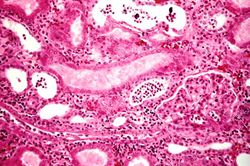 This high-power photomicrograph demonstrates the cellular infiltrate within the interstitium and cells within the renal tubules.


Virtual Microscopy
Study Questions
Additional Resources
Reference
- eMedicine Medical Library: Assessment and Management of the Renal Transplant Patient
- eMedicine Medical Library: Renal Transplantation
- Merck Manual: Nephrotic Syndrome
- Merck Manual: Chronic Kidney Disease
- Merck Manual: Hemodialysis
- Merck Manual: Kidney Transplantation
Journal Articles
- Matas AJ. Impact of acute rejection on development of chronic rejection in pediatric renal transplant recipients. Pediatr Transplant 2000 May;4(2):92-9.
Images
Related IPLab Cases
- Lab 1: Kidney: Infarction (Coagulative Necrosis)
- Lab 6: Kidney: Chronic Transplant Rejection
- Lab 10: Kidney: Candidiasis