IPLab:Lab 2:Hyperplasia
Jump to navigation
Jump to search
Clinical Summary
This 87-year-old man has had a three year history of difficulty in starting his urine stream. He was seen several times in the emergency room for acute urinary retention and dysuria. On several occasions, significant numbers of white blood cells and bacteria (suggestive of acute cystitis) were noted in the patient's urine specimen.
Terminally, the patient developed fever, confusion that progressed to coma, convulsions, and shock. At the time of his death, the patient's major clinical problem was Gram-negative sepsis secondary to a urinary tract infection.
At autopsy the prostate gland was grossly enlarged (6.5 x 4.8 x 3.2 cm) and weighed 75 grams. The prostate gland was nodular but the nodules were confined within the prostatic capsule.
Images
-
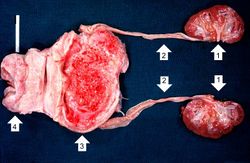 This photograph shows the autopsy specimen from this patient. Included are kidneys (1), ureters (2), bladder (3) (which has been opened), and enlarged prostate (4). Note that the bladder mucosa has multiple trabeculae and the bladder mucosa is hyperemic. Also note that the ureters are dilated.
 -
 This is a close-up of the prostate from this same patient. Note the nodularity of the tissue (1) and the enlargement of the gland. Enlargement of the prostate leads to compression of the urethra as it passes through (2) the gland.
 -
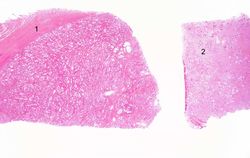 This is a low-power photomicrograph showing hyperplastic prostate on the left (1) and normal prostate on the right (2). At this power, dilated glands are visible in the section of hyperplastic prostate.
 -
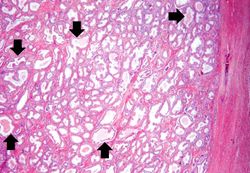 The dilated glands (arrows) make up the major portion of the prostate tissue and there is compression of the stroma.
 -
 Cystic dilatation of glands is present in this photomicrograph. Notice the accumulation of secretory material inside the glands (arrows) and compression (thinning) of the lining epithelium.
 -
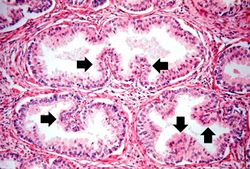 A higher-power view shows the papillary folds (arrows) produced by the hyperplastic epithelium projecting into the lumen of the gland. While these papillary folds project into the lumen of the gland, there is no extension through the glandular basement membrane into the gland's stroma.
 -
 This is a higher-power photomicrograph of papillary folds of hyperplastic epithelium (arrows).
 -
 This kidney was removed from another autopsy patient who had prostatic hyperplasia resulting in marked urinary retention and back-flow of urine from the bladder into the ureters and renal pelvis. The increased pressure inside the renal pelvis resulted in dilation of the renal pelvis (1) and pressure atrophy of the cortex (2). This change in the kidney is called hydronephrosis.


Virtual Microscopy
Prostatic Hyperplasia
Normal Prostate
Study Questions
Additional Resources
Reference
Journal Articles
- Wang TJ, Slawin KM, Rittenhouse HG, Millar LS, Mikolajczyk SD. Benign prostatic hyperplasia-associated prostate-specific antigen (BPSA) shows unique immunoreactivity with anti-PSA monoclonal antibodies. Eur J Biochem 2000 Jul;267(13):4040-5.
Images
| |||||