IPLab:Lab 12:Acetaminophen Toxicity
Jump to navigation
Jump to search
Clinical Summary
This 77-year-old white male with a past medical history of severe osteo- and rheumatoid arthritis went to his internist for increasing joint pain and was started on a new medication containing a narcotic analgesic, acetaminophen, and a non-steroidal anti-inflammatory agent. The patient also self medicated with acetaminophen. Two days later he went back to his doctor complaining of nausea and vomiting, right upper quadrant pain, anorexia, and confusion. Lab evaluation revealed massively increased liver enzymes. The patient went into DIC and died in fulminant liver failure.
At autopsy the liver had large areas of pale softened tissue indicative of liver necrosis.
Images
-
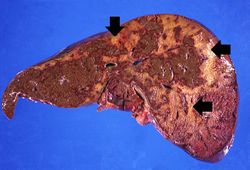 This gross photograph of the liver from this patient demonstrates the pale areas of necrosis (arrows).
 -
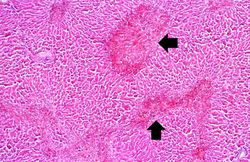 In this photomicrograph of the liver from this patient there are areas of hemorrhagic necrosis (arrows).
 -
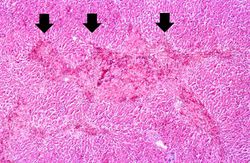 This is another example of the areas of hemorrhagic necrosis (arrows).
 -
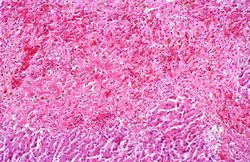 This is a medium-power photomicrograph of the areas of hemorrhagic necrosis. Note the coagulation necrosis and hemorrhage in this area. Viable hepatocytes can be seen along the edge of this lesion.
 -
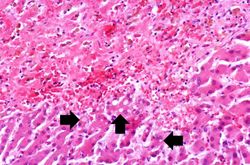 This is a high-power photomicrograph of the edge of the necrosis. Again, note the coagulation necrosis and hemorrhage in this area. The viable hepatocytes at the edge of this necrosis are vacuolated (arrows).
 -
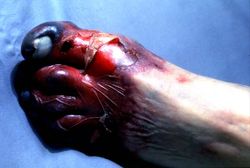 Photograph taken at autopsy demonstrating the severe necrosis of the skin of foot.
 -
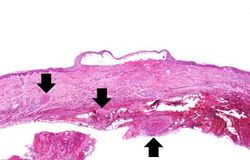 This low-power photomicrograph of the skin from this patient shows a blister and numerous thrombosed vessels (arrows) in the dermis.
 -
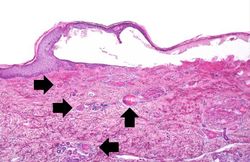 This is a higher-power photomicrograph of the skin from this patient showing a blister and the thrombosed small vessels (arrows) in the dermis.


Virtual Microscopy
Liver: Acetominophen Toxicity
Normal Liver
Study Questions
Additional Resources
Reference
- eMedicine Medical Library: Acetaminophen Toxicity
- eMedicine Medical Library: Acute Liver Failure
- Merck Manual: Acetaminophen Poisoning
Journal Articles
- Schiødt FV, Lee WM, Bondesen S, Ott P, Christensen E. Influence of acute and chronic alcohol intake on the clinical course and outcome in acetaminophen overdose. Aliment Pharmacol Ther 2002 Apr;16(4):707-15.
- Yeates PJ, Thomas SH. Effectiveness of delayed activated charcoal administration in simulated paracetamol (acetaminophen) overdose. Br J Clin Pharmacol 2000 Jan;49(1):11-4.
Images
Related IPLab Cases
| |||||