IPLab:Lab 6:Graves Disease
Clinical Summary
This 18-year-old girl presented with complaints of swelling in the neck, weight loss, bulging of the eyes, tremor, decreased heat tolerance, loose stools, and occasional palpitations. Physical examination revealed normal blood pressure, resting tachycardia of 110 beats per minute, mild exophthalmos, eyelid lag, and a diffusely enlarged thyroid gland. Pertinent laboratory findings were thyroxine (T4) level 30.8 mcg/dL, free thyroxine was 2.7 ng/dL , and thyroid stimulating hormone (TSH) was 0.22 mcIU/mL . She was given propylthiouracil until she became nearly euthyroid, at which time a thyroidectomy was done. The thyroid gland weighed 45 grams. It was beefy red in color and had a homogeneous fleshy consistency.
Images
-
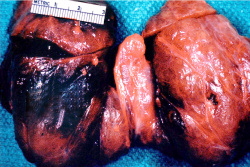 This is a photograph of the thyroid from this case. Note that the gland is enlarged and is dark red.
 -
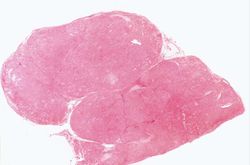 This is a low-power photomicrograph of thyroid tissue from this case. The tissue is very cellular with very little colloid.
 -
 This is a higher-power photomicrograph of thyroid. The tissue is very cellular and there is much less colloid (C) filling the glands than is normally seen.
 -
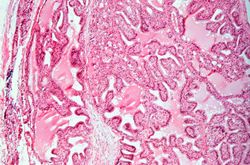 This is a high-power photomicrograph of thyroid. Note the cellularity of the tissue with marked infolding of the epithelial tissue.
 -
 This is a high-power photomicrograph of thyroid. Note the papillary projections and the “scalloped” or “moth-eaten” appearance (arrows) of the colloid (C). This appearance indicates active absorption of the colloid to form thyroglobulin.
 -
 This is a gross photograph of a thyroid from a case of nodular goiter.
 -
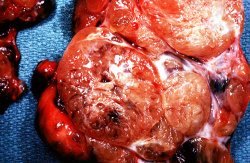 Closer view of cut surface of the thyroid with nodular goiter. Note the multilobular appearance of the tissue.


Virtual Microscopy
Study Questions
Additional Resources
Reference
- eMedicine Medical Library: Pediatric Graves Disease
- eMedicine Medical Library: Hyperthyroidism, Thyroid Storm, and Graves Disease
- eMedicine Medical Library: Goiter
- eMedicine Medical Library: Diffuse Toxic Goiter
- Merck Manual: Overview of Thyroid Function
- Merck Manual: Hyperthyroidism
Journal Articles
- Smith TJ and Hegedüs L. Graves’ Disease. NEJM 2016 375:1552-1565.
- Fraser T, Green D. Weathering the storm: beta-blockade and the potential for disaster in severe hyperthyroidism. Emerg Med (Fremantle) 2001 Sep;13(3):376-80.