IPLab:Lab 13:Meningococcemia: Difference between revisions
Jump to navigation
Jump to search
Seung Park (talk | contribs) |
|||
| Line 1: | Line 1: | ||
== Clinical Summary == | == Clinical Summary == | ||
This 20-month-old black female was active and without complaint until 4 p.m. on the evening prior to her death, when according to her mother she acted as if she did not feel well. The mother reported that the child had felt warm at bedtime (8 p.m.) so she had given her some acetaminophen. At midnight, the child was given another dose of acetaminophen. The child slept with her mother that night who reported last hearing her daughter make a sound at approximately 7:30 a.m. The mother checked in on her daughter at 8:45 a.m. and found her to be unresponsive. The girl was dead when paramedics arrived. Her past medical history was unremarkable and there had been no recent illness among other family members. | This 20-month-old black female was active and without complaint until 4 p.m. on the evening prior to her death, when according to her mother she acted as if she did not feel well. The mother reported that the child had felt warm at bedtime (8 p.m.) so she had given her some acetaminophen. At midnight, the child was given another dose of acetaminophen. The child slept with her mother that night who reported last hearing her daughter make a sound at approximately 7:30 a.m. The mother checked in on her daughter at 8:45 a.m. and found her to be unresponsive. The girl was dead when paramedics arrived. Her past medical history was unremarkable and there had been no recent illness among other family members. | ||
== Images == | == Images == | ||
Revision as of 16:37, 9 July 2020
Clinical Summary
This 20-month-old black female was active and without complaint until 4 p.m. on the evening prior to her death, when according to her mother she acted as if she did not feel well. The mother reported that the child had felt warm at bedtime (8 p.m.) so she had given her some acetaminophen. At midnight, the child was given another dose of acetaminophen. The child slept with her mother that night who reported last hearing her daughter make a sound at approximately 7:30 a.m. The mother checked in on her daughter at 8:45 a.m. and found her to be unresponsive. The girl was dead when paramedics arrived. Her past medical history was unremarkable and there had been no recent illness among other family members.
Images
-
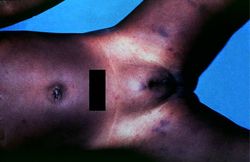 In this gross photograph from the autopsy, note the areas of hemorrhage in the inguinal region.
 -
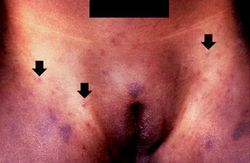 This is a closer view of the inguinal region taken at autopsy. The areas of hemorrhage include purpura and petechiae (arrows).
 -
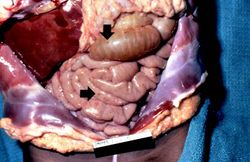 In this gross photograph of the abdomen taken at the autopsy, there are petechial hemorrhages on the viscera (arrows).
 -
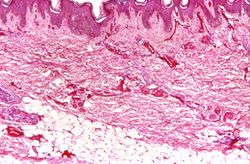 This photomicrograph of the skin shows thrombi and fibrin clots in small vessels in the dermis. This is indicative of the endothelial damage caused by the Neisseria meningitidis endotoxin. This endotoxin-induced damage to the endothelium of small blood vessels throughout the body results in widespread petechiae and purpura.
 -
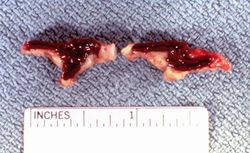 This is a gross photograph of cross sections through the adrenal glands from this case. Both adrenal glands are markedly hemorrhagic.
 -
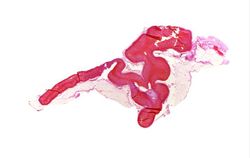 This is a low-power photomicrograph of the adrenal gland from this case. Note that the entire gland is hemorrhagic.
 -
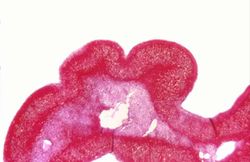 This higher-power photomicrograph of the adrenal gland from this case provides an example of hemorrhagic necrosis.
 -
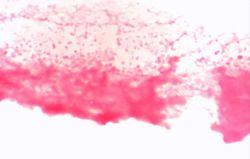 This is a higher-power photomicrograph of a smear of cerebrospinal fluid taken at autopsy. Note the Gram-negative cocci in this smear, indicative of N. meningitidis.


Study Questions
Additional Resources
Reference
Journal Articles
- Leclerc F, Leteurtre S, Cremer R, Fourier C, Sadik A. Do new strategies in meningococcemia produce better outcomes? Crit Care Med 2000 Sep;28(9 Suppl):S60-3.
Images
| |||||