IPLab:Lab 2:Fatty Change and Cirrhosis: Difference between revisions
No edit summary |
No edit summary |
||
| Line 34: | Line 34: | ||
In this case, alcohol abuse (toxin) is the most likely etiologic agent. | In this case, alcohol abuse (toxin) is the most likely etiologic agent. | ||
</spoiler> | </spoiler> | ||
* <spoiler text=" "> | * <spoiler text="What causes hepatocellular steatosis in an alcoholic?">Alcohol induces hepatic steatosis primarily by: | ||
* the shunting of normal substrates away from catabolism and toward biosynthesis due to generation of excess NADH by alcohol dehydrogenase, | |||
* impaired assembly and secretions of lipoproteins, | |||
* and increased peripheral catabolism of fat. | |||
Many other factors also come into play.</spoiler> | |||
* <spoiler text=" "> </spoiler> | * <spoiler text=" "> </spoiler> | ||
Revision as of 10:11, 21 August 2013
Clinical Summary
This 54-year-old man with a long history of alcohol abuse had been admitted to the hospital numerous times for abdominal pain thought to be due to gastritis or a peptic ulcer. On several occasions his serum amylase level was elevated into the range of 300-500 u/L indicating relapsing or recurrent pancreatitis. Three weeks prior to his demise, the patient began an alcoholic binge. The binge continued until three days prior to the patient's death at which time he developed fever and malaise, prompting him to cease drinking. He was brought to the hospital semi-comatose and with a fever of 105.4°F. Shortly after arriving at the hospital, the patient died from massive pneumonia.
Autopsy Findings
At autopsy, a necrotizing lobar pneumonia was present which contained organisms consistent with Klebsiella pneumoniae. The liver was enlarged--weighing 2700 grams--and had a yellow-orange color. The liver was firm to palpation and the cut surface had a slightly granular appearance suggestive of early cirrhosis. The pancreas showed multiple areas of fibrosis.
Images
-
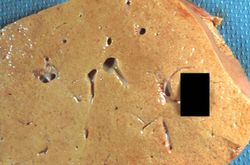 This gross photograph of liver tissue illustrates the yellowish color of the liver parenchyma. The yellow color indicates high fat content in this tissue. Compare this with the normal dark red color of liver.
 -
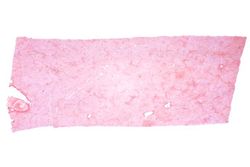 This low-power photomicrograph of liver illustrates a very pale-staining section with a uniform appearance throughout the section.
 -
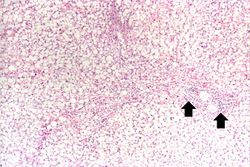 Another low-power photomicrograph illustrates again the pale, washed-out appearance of this tissue. Notice the numerous holes throughout the tissue. There are accumulations of inflammatory cells (arrows) around portal tracts.
 -
 A higher-power photomicrograph illustrates more clearly the inflammatory cells (arrows) around the portal areas.
 -
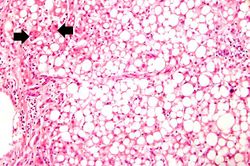 This higher-power photomicrograph of the centrilobular area gives the appearance of fatty tissue, as indicated by many empty spaces. Very few normal liver cells can be seen in this slide. A few more normal-appearing hepatocytes are present at the left portion of the slide (arrows).
 -
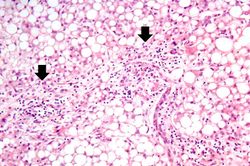 Another view at the same power illustrates the proliferation of bile ducts in the interlobular and perichordal regions (arrows).
 -
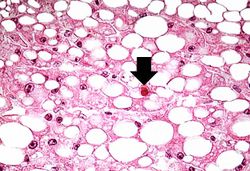 A high-power photomicrograph of the liver parenchyma shows that each individual liver cell is filled with a large, clear droplet which represents the space remaining after lipid was dissolved by the dehydration procedure used to embed the tissue. Note that each empty space is surrounded by a thin rim of eosinophilic cytoplasm; in many instances, the hepatocyte nucleus can be seen as well. The red body (arrow) seen within a cell in the center of the slide is an acidophilic body associated with alcoholic hepatitis.
 -
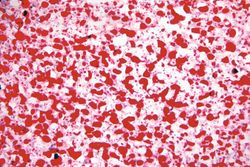 An oil red O stain for fat was performed on a frozen section of this liver tissue. The red droplets represent fat in the tissue which is typical of fatty degeneration in the liver. By using frozen sections the tissues do not have to be dehydrated through alcohol solutions and thus the fat does not get washed out.
 -
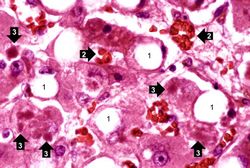 This photomicrograph of the liver is from another patient with a history of alcohol use. There are some clear vacuoles indicating fat droplets (1) and there are numerous red-staining granular deposits within the cytoplasm of hepatocytes (2)this is alcoholic hyalin. Alcoholic hyalin is easily distinguished from red blood cells (3) that are also present in this section.
 -
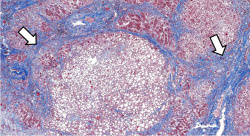 This is a low-power photomicrograph of liver stained with a trichrome stain. In this section, connective tissue stains green (arrows) and hepatic parenchymal cells are red. Note that many of the parenchymal cells have clear spaces indicating fatty degeneration. The proliferation of scar tissue between the liver lobules is the result of cirrhosis.
 -
-
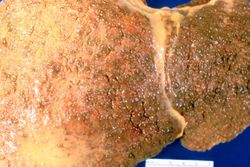
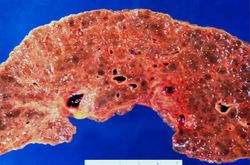 This is a cut surface of the same tissue seen in the previous slide. Note the marked nodular pattern. The paler-staining areas between the round nodules represent fibrous connective tissue.


Study Questions
| |||||