IPLab:Lab 4:Thrombosis: Difference between revisions
Seung Park (talk | contribs) No edit summary |
Seung Park (talk | contribs) No edit summary |
||
| Line 25: | Line 25: | ||
* <spoiler text="What is the source for the fibroblasts and endothelial cells that are present in organizing thrombi?">Organization of a thrombus involves a process similar to the normal healing response. First there is inflammation with macrophages that phagocytose the thrombotic material. Then fibroblasts and endothelial cells from the vessel wall and the vasa vasorum of the vessel migrate into thrombotic material. This process results in a picture similar to granulation tissue in a healing wound.</spoiler> | * <spoiler text="What is the source for the fibroblasts and endothelial cells that are present in organizing thrombi?">Organization of a thrombus involves a process similar to the normal healing response. First there is inflammation with macrophages that phagocytose the thrombotic material. Then fibroblasts and endothelial cells from the vessel wall and the vasa vasorum of the vessel migrate into thrombotic material. This process results in a picture similar to granulation tissue in a healing wound.</spoiler> | ||
* <spoiler text="Does recanalization of a thrombus results in normal blood flow to the tissue?">Usually not. The recanalized lumen is not very large and by the time the thrombus is recanalized, the tissue supplied by that artery is usually already dead. Any blood flow down this vessel will help to accelerate the wound healing process in the tissue downstream.</spoiler> | * <spoiler text="Does recanalization of a thrombus results in normal blood flow to the tissue?">Usually not. The recanalized lumen is not very large and by the time the thrombus is recanalized, the tissue supplied by that artery is usually already dead. Any blood flow down this vessel will help to accelerate the wound healing process in the tissue downstream.</spoiler> | ||
== Additional Resources == | |||
=== Reference === | |||
* [http://emedicine.medscape.com/article/1950759-overview eMedicine Medical Library: Noncoronary Atherosclerosis] | |||
* [http://emedicine.medscape.com/article/155919-overview eMedicine Medical Library: Myocardial Infarction] | |||
* [http://www.merckmanuals.com/professional/hematology_and_oncology/thrombotic_disorders/overview_of_thrombotic_disorders.html Merck Manual: Thrombotic Disorders] | |||
* [http://www.merckmanuals.com/professional/cardiovascular_disorders/coronary_artery_disease/acute_coronary_syndromes_acs.html Merck Manual: Acute Coronary Syndromes (ACS)] | |||
=== Journal Articles === | |||
* Jaeger BR. [http://www.ncbi.nlm.nih.gov/pubmed/11467757 Evidence for maximal treatment of atherosclerosis: drastic reduction of cholesterol and fibrinogen restores vascular homeostasis]. ''Ther Apher'' 2001 Jun;5(3):207-11. | |||
=== Images === | |||
* [http://peir.path.uab.edu/library/index.php?/tags/34-coronary_artery PEIR Digital Library: Coronary Artery Images] | |||
* [http://library.med.utah.edu/WebPath/CVHTML/CVIDX.html WebPath: Cardiovascular Pathology] | |||
== Related IPLab Cases == | |||
* [[IPLab:Lab 1:Myocardial Infarction|Lab 1: Heart: Myocardial Infarction (Coagulative Necrosis)]] | |||
* [[IPLab:Lab 3:Acute Myocardial Infarction|Lab 3: Heart: Acute Myocardial Infarction]] | |||
* [[IPLab:Lab 3:Healed Myocardial Infarction|Lab 3: Heart: Healed Myocardial Infarction]] | |||
* [[IPLab:Lab 4:Mural Thrombus|Lab 4: Heart: Mural Thrombus]] | |||
* [[IPLab:Lab 4:Pulmonary Congestion and Edema|Lab 4: Lung: Pulmonary Congestion and Edema]] | |||
{{IPLab 4}} | {{IPLab 4}} | ||
[[Category: IPLab:Lab 4]] | [[Category: IPLab:Lab 4]] | ||
Revision as of 02:58, 22 August 2013
Clinical Summary
This 83-year-old white male was admitted with the chief complaint of chest pain. He had been awakened the previous night with dull chest pain which was retrosternal and radiated through to his back. The pain was associated with sweating, nausea, and vomiting and could not be relieved by antacids. Nitroglycerin gave prompt relief. Following admission he developed cardiac arrhythmias. His AST was found to be 130 IU/L. In the early morning of the day after admission, he developed severe epigastric pain and several episodes of tachycardia (150-160 beats per minute) and later cardiac standstill. He expired less than a day after admission. There was a history of hypertension and diabetes.
Autopsy Findings
The heart weighed 500 grams. There was massive acute myocardial infarction (about 2 days old) involving the posterior left ventricle, interventricular septum, and right ventricle from apex to base. The infarct was transmural, and there was a small rupture in the soft infarcted area at the apex. There were 1200 mL of blood within the right pleural cavity, probably secondary to this rupture. The coronary arteries showed moderate to severe atherosclerosis throughout the coronary tree.
Images
-
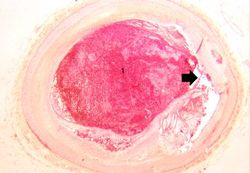
 This is a gross photograph of thrombosed coronary artery (arrows).
 -
-
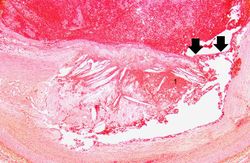 This is a higher-power photomicrograph of the ruptured fibrous cap (arrows) with hemorrhage (1) into the atherosclerotic plaque.
 -
 This is another high-power photomicrograph of the ruptured fibrous cap (arrows) with hemorrhage (1) into the atherosclerotic plaque. Note the presence of cholesterol crystals.
 -

-
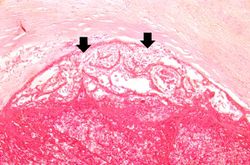 This is a higher-power photomicrograph of thrombus attached to the wall of the vessel. Note the early organization with in-growth of fibroblasts and small blood vessels from the wall of the artery (arrows).
 -
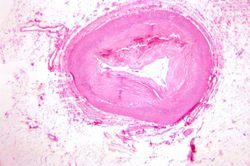 In this low-power photomicrograph of another coronary artery from this patient, a mural thrombus has undergone re-organization. The mural thrombus has been invaded by the in-growth of fibroblasts and small blood vessels from the wall of the artery. The thrombotic material has been phagocytosed and removed by macrophages and is replaced by fibrous connective tissue and blood vessels. This re-organized thrombus still compromises the lumen of this vessel.
 -
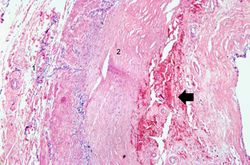 This is a higher-power photomicrograph of the vessel wall. The adventitia (1) and the media (2) contain inflammatory cells. The recanalized portion of the vessel is composed of fibrous connective tissue and contains numerous small blood vessels. There is a small area of hemorrhage (arrow) in the central portion of this image.
 -
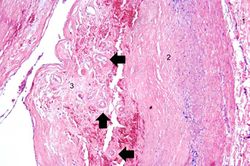 This is a higher-power photomicrograph of another region of the vessel wall. The adventitia (1) and the media (2) contain inflammatory cells. The recanalized portion of the vessel (3) is composed of fibrous connective tissue and contains numerous small blood vessels (arrows).
 -
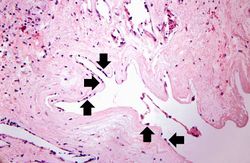 This is a high-power photomicrograph of the luminal surface of a re-canalized vessel. Note that the vessel lumen is lined by endothelial cells (arrows).


Study Questions
- What is the source for the fibroblasts and endothelial cells that are present in organizing thrombi?
Additional Resources
Reference
- eMedicine Medical Library: Noncoronary Atherosclerosis
- eMedicine Medical Library: Myocardial Infarction
- Merck Manual: Thrombotic Disorders
- Merck Manual: Acute Coronary Syndromes (ACS)
Journal Articles
- Jaeger BR. Evidence for maximal treatment of atherosclerosis: drastic reduction of cholesterol and fibrinogen restores vascular homeostasis. Ther Apher 2001 Jun;5(3):207-11.
Images
Related IPLab Cases
- Lab 1: Heart: Myocardial Infarction (Coagulative Necrosis)
- Lab 3: Heart: Acute Myocardial Infarction
- Lab 3: Heart: Healed Myocardial Infarction
- Lab 4: Heart: Mural Thrombus
- Lab 4: Lung: Pulmonary Congestion and Edema
| |||||