IPLab:Lab 9:Bacterial Meningitis: Difference between revisions
Jump to navigation
Jump to search
| Line 1: | Line 1: | ||
== Clinical Summary == | == Clinical Summary == | ||
This 45-year-old white female with a history of psychiatric illness sustained self-inflicted third degree burns over 49% of her body surface. After initially doing well under treatment, she developed severe respiratory distress and became comatose. Antemortem blood cultures were positive for Pseudomonas aeruginosa. | This 45-year-old white female with a history of psychiatric illness sustained self-inflicted third degree burns over 49% of her body surface. After initially doing well under treatment, she developed severe respiratory distress and became comatose. Antemortem blood cultures were positive for Pseudomonas aeruginosa. | ||
At autopsy the principal findings were in the lungs and brain. Bronchopneumonia was present in all lobes of both lungs. The brain weighed 1450 grams and the leptomeninges contained a thick yellow purulent exudate most prominent over the frontoparietal areas and at the base of the brain. | |||
== Images == | == Images == | ||
Latest revision as of 16:42, 9 July 2020
Clinical Summary
This 45-year-old white female with a history of psychiatric illness sustained self-inflicted third degree burns over 49% of her body surface. After initially doing well under treatment, she developed severe respiratory distress and became comatose. Antemortem blood cultures were positive for Pseudomonas aeruginosa.
At autopsy the principal findings were in the lungs and brain. Bronchopneumonia was present in all lobes of both lungs. The brain weighed 1450 grams and the leptomeninges contained a thick yellow purulent exudate most prominent over the frontoparietal areas and at the base of the brain.
Images
-
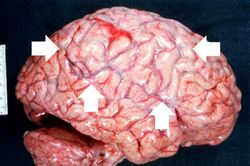 This gross photograph of the autopsy specimen from this case demonstrates the purulent exudate (arrows) in the leptomeninges.
 -
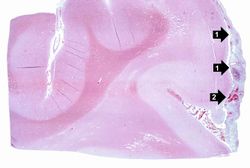 This is a low-power photomicrograph of brain section. Note the exudate (1) in the meninges and congestion of the vessels (2) in the leptomeninges.
 -
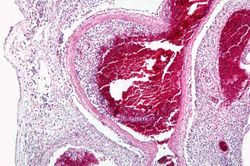 This is a higher-power view of a congested blood vessel. Inflammatory exudate is present within the vessel and throughout the leptomeninges.
 -
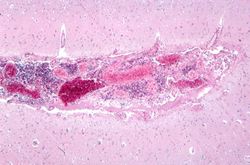 This higher-power photomicrograph of a sulcus shows the congested vessels and the inflammatory exudate in the leptomeninges.
 -
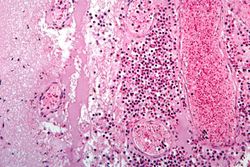 This is a higher-power photomicrograph of inflammatory exudate in a sulcus. The majority of cells in this exudate are neutrophils. There is also abundant fibrin (arrows) and red blood cells are present in the congested vessels.
 -
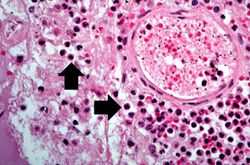 This is a high-power photomicrograph of a blood vessel from the previous image. The vessel is surrounded by neutrophils (arrows).
 -
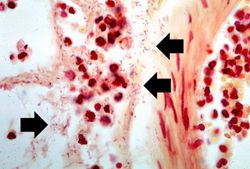 This is a high-power photomicrograph of exudate from the leptomeninges which has been Gram-stained. Note the Gram-negative bacteria (arrows) throughout this section.
 -
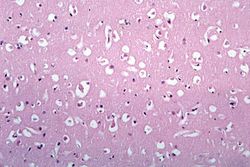 This photomicrograph of brain tissue demonstrates diffuse edema.


Virtual Microscopy
Study Questions
Additional Resources
Reference
- eMedicine Medical Library: Pediatric Bacterial Meningitis
- eMedicine Medical Library: Meningitis
- eMedicine Medical Library: Thermal Burns
- eMedicine Medical Library: Pseudomonas aeruginosa Infections
- Merck Manual: Acute Bacterial Meningitis
- Merck Manual: Burns
Journal Articles
- Grände PO, Myhre EB, Nordström CH, Schliamser S. Treatment of intracranial hypertension and aspects on lumbar dural puncture in severe bacterial meningitis. Acta Anaesthesiol Scand 2002 Mar;46(3):264-70.
Images
| |||||