IPLab:Lab 4:Atheromatous Emboli
Clinical Summary
This 71-year-old male was admitted to the hospital with dry gangrene of the left great toe. Subsequently, he was found to have a poorly differentiated adenocarcinoma of the left upper lobe of the lung. He developed a perforation of a duodenal ulcer with generalized peritonitis and died five days after admission.
Autopsy Findings
Gross examination of the aorta revealed severe atherosclerosis with extensive mural thrombus formation. Recent infarcts were noted in the spleen and in the left kidney. An old posterior myocardial infarct was noted. The left iliac artery also appeared to be almost totally occluded. A whitish-tan tumor was noted in the apical portion of the left upper lobe of the lung with metastases in the carinal and hilar lymph nodes.
Images
-
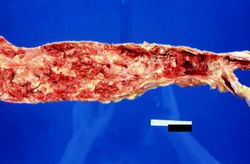 This is a gross photograph of the aorta from this patient opened lengthwise with the luminal surface visible. Note the rough surface with ulcerations and adherent thrombotic material. There is a mild dilation (aneurysm) at the distal aorta just at the bifurcation with an accumulation of thrombus.
 -
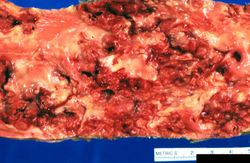 This is a closer view of the luminal surface of the aorta from the previous image. The rough, ulcerated surface and the thrombotic material can be easily seen in this image.
 -
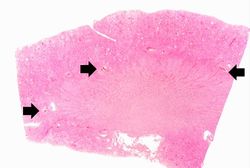 This is a low-power photomicrograph of kidney tissue. Several blood vessels can be identified at the corticomedullary junction (arrows).
 -
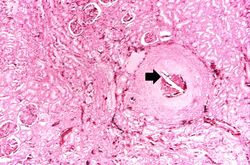 This higher-power photomicrograph of one of the arcuate arteries reveals a cholesterol embolus. Note the needle-shaped space (arrow) within the lumen of this artery (arrow) which represents the space occupied by the cholesterol crystal that was dissolved away during histologic processing.
 -
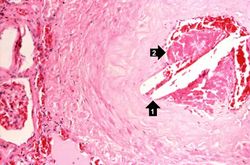 This is another view of this vessel with an atherosclerotic embolus. Note the cholesterol clefts (1) and thrombotic material (2) that occlude this artery.
 -
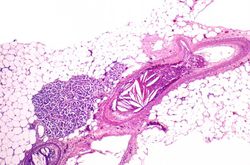 A mesenteric artery also had an atherosclerotic embolus. Again note the cholesterol clefts and thrombotic material that occlude this artery.


Virtual Microscopy
Kidney: Atheromatous Emboli
<peir-vm>IPLab4AtheromatousEmboli</peir-vm>
Normal Kidney
<peir-vm>UAB-Histology-00114</peir-vm>
Study Questions
- <spoiler text="What is the cause of atheromatous emboli?">Ulcerated or complex atherosclerotic plaques rupture and release cholesterol and other material into the blood stream. These materials lodge in vessels downstream. Ulceration or rupture of atherosclerotic plaques is part of the normal progression of atherosclerosis.</spoiler>
- <spoiler text="What happens when atherosclerotic material embolizes?">When the atherosclerotic plaque ruptures collagen, cholesterol esters and necrotic material are exposed to the blood stream. This initiates thrombus formation. So, in addition to the cholesterol embolizing to distal vessels, thrombosis is also initiated and can obstruct vessels.</spoiler>
- <spoiler text="What other types of material can embolize and cause clinical problems?">Probably 99% of all emboli are thromboemboli. Other materials that can embolize are: fragments of bone or bone marrow, fat, tumor cells, foreign bodies such as bullets, and bubbles of air or nitrogen.</spoiler>
Additional Resources
Reference
- eMedicine Medical Library: Noncoronary Atherosclerosis
- eMedicine Medical Library: Cholesterol Embolism
- Merck Manual: Thrombotic Disorders
Journal Articles
- Scolari F, Ravani P. Atheroembolic renal disease. Lancet 2010 May 8;375(9726):1650-60.
Images
- PEIR Digital Library: Kidney Images
- WebPath: Atherosclerosis and Thrombosis
- WebPath: Cardiovascular Pathology
- WebPath: Renal Pathology
Related IPLab Cases
| |||||