IPLab:Lab 4:Thromboembolus: Difference between revisions
Jump to navigation
Jump to search
| Line 3: | Line 3: | ||
At autopsy, thrombi were found in the femoral and iliac veins, as well as in the larger pulmonary arteries. | At autopsy, thrombi were found in the femoral and iliac veins, as well as in the larger pulmonary arteries. | ||
== Images == | == Images == | ||
Latest revision as of 01:59, 24 June 2020
Clinical Summary
This 67-year-old male was hospitalized because of extensive atherosclerotic cardiovascular disease. Following surgery, during which diseased portions of the femoral arteries were bypassed, he developed massive pulmonary embolization and expired.
At autopsy, thrombi were found in the femoral and iliac veins, as well as in the larger pulmonary arteries.
Images
-
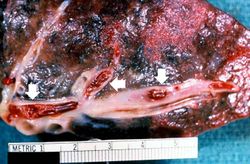 This is a gross photograph of a cut section of lung demonstrating thromboemboli in the pulmonary arteries (arrows).
 -
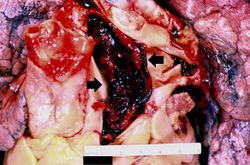 This is a gross photograph of the heart with the main pulmonary artery opened. Note the thromboembolus filling the pulmonary artery (arrows).
 -
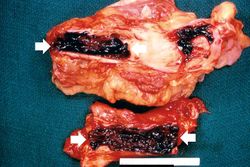 This is a gross photograph of portions of muscle from the legs including sections of leg veins. Note that the leg veins contain thrombus (arrows).
 -
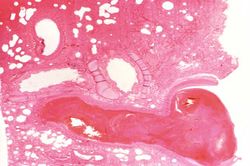 This is a low-power photomicrograph of lung. A large thrombus is lodged at this branch point in the pulmonary artery. Note the hemorrhage and congestion in the surrounding lung parenchyma.
 -
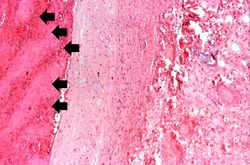 This is a photomicrograph of the wall of the pulmonary artery (1) containing the thromboembolus. In this case the artery wall looks normal. If this was a thrombus instead of a thromboembolus, you would expect to see some damage in the artery wall that would have initiated the thrombus. Note the lines of Zahn in the thromboembolus (arrows).
 -
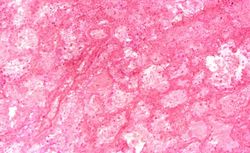 This is a low-power photomicrograph of the infarcted lung. The tissue is congested and has a very bland appearance due to coagulation necrosis of the lung parenchyma. You can still see the outlines of the alveoli and the cells that make-up the alveoli but there is almost complete loss of nuclei throughout this section.
 -
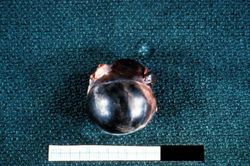 This is a gross photograph of an infarcted testis. Because of the anatomy of the blood supply to the testis, torsion or the blood vessels often leads to venous occlusion (due to compression of the thin walled veins) but not arterial occlusion. Thus, blood still flows into the testis but it can’t get out! This leads to hypoxia and eventually to hemorrhagic necrosis.
 -
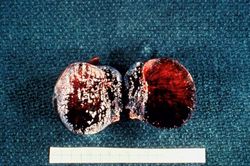 This is a gross photograph of cut section of testis from previous image. The tissue is filled with blood.
 -
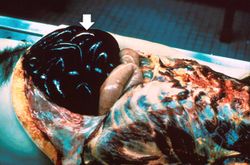 This is a gross photograph of an opened abdomen at autopsy demonstrating loops of infarcted bowel (arrow). Vascular occlusion can lead to ischemic necrosis of the bowel. In this case, a section of bowel herniated through a fibrous connective tissue band and was strangulated, leading to ischemic necrosis.
 -
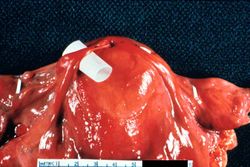 This is a gross photograph of the fibrous band between the uterus and adjacent tissues. This fibrous scar tissue is probably left over from a previous surgery or an infection. A loop of bowel herniated through the opening produced by this fibrous band and became incarcerated leading to the ischemic necrosis seen in the previous image.


Virtual Microscopy
Lung: Thromboembolus
<peir-vm>IPLab4Thromboembolus</peir-vm>
Normal Lung
<peir-vm>UAB-Histology-00107</peir-vm>
Study Questions
- <spoiler text="What are the common sources for pulmonary thromboemboli?">Large deep veins of the lower legs: popliteal, femoral, and iliac veins.</spoiler>
- <spoiler text="What are the clinical sequelae of pulmonary thromboemboli?">Most (60-80%) pulmonary thromboemboli are clinically silent. In the remainder of the cases, pulmonary thromboemboli can cause sudden death, acute or chronic cor pulmonale, infarction, or hemorrhage.</spoiler>
- <spoiler text="What is a paradoxical embolism?">When a venous embolus passes through an interatrial or interventricular septal defect and enters the systemic circulation.</spoiler>
Additional Resources
Reference
- eMedicine Medical Library: Pulmonary Embolism
- eMedicine Medical Library: Deep Venous Thrombosis
- eMedicine Medical Library: Noncoronary Atherosclerosis
- Merck Manual: Thrombotic Disorders
- Merck Manual: Pulmonary Embolism
- Merck Manual: Deep Venous Thrombosis
Journal Articles
- Garg K. CT of pulmonary thromboembolic disease. Radiol Clin North Am 2002 Jan;40(1):111-22, ix.
Images
Related IPLab Cases
| |||||