IPLab:Lab 4:Pulmonary Congestion and Edema: Difference between revisions
Jump to navigation
Jump to search
Seung Park (talk | contribs) No edit summary |
Seung Park (talk | contribs) No edit summary |
||
| Line 27: | Line 27: | ||
** <spoiler text="hydropericardium">Hydropericardium: fluid build-up in the pericardial sac.</spoiler> | ** <spoiler text="hydropericardium">Hydropericardium: fluid build-up in the pericardial sac.</spoiler> | ||
** <spoiler text="hydroperitoneum">Hydroperitoneum: fluid accumulation in the abdominal cavity--also referred to as ascites.</spoiler> | ** <spoiler text="hydroperitoneum">Hydroperitoneum: fluid accumulation in the abdominal cavity--also referred to as ascites.</spoiler> | ||
* What is the most common cause of pulmonary edema?">Left-sided heart failure.</spoiler> | * <spoiler text="What is the most common cause of pulmonary edema?">Left-sided heart failure.</spoiler> | ||
{{IPLab 4}} | {{IPLab 4}} | ||
[[Category: IPLab:Lab 4]] | [[Category: IPLab:Lab 4]] | ||
Revision as of 09:50, 21 August 2013
Clinical Summary
This 69-year-old white male with well-controlled Type I diabetes mellitus (insulin-dependent) presented with upper abdominal and lower chest pain of four hours duration and accompanied by shortness of breath and diaphoresis. An electrocardiogram revealed multiple premature ventricular contractions (PVCs). The hospital course was characterized by recurrent pulmonary edema and oliguria. The terminal event was cardiac arrest.
Autopsy Findings
Significant findings at postmortem examination were old and recent myocardial infarctions and evidence of congestive heart failure. The right and left lungs weighed 950 grams and 750 grams, respectively, and were reddish-brown.
Images
-
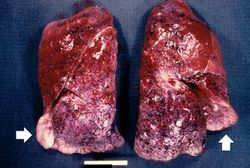 This is a gross photograph of lungs that are distended and red. The reddish coloration of the tissue is due to congestion. Some normal pink lung tissue is seen at the edges of the lungs (arrows).
 -
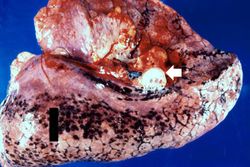 This is a gross photograph of lung demonstrating acute pulmonary congestion and edema. A frothy exudate fills the bronchus (arrow).
 -
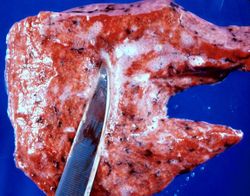 This gross photograph demonstrates the frothy exudate that is being extruded from the lung tissue.
 -
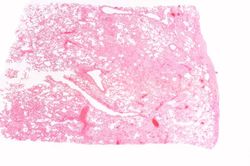 This is a low-power photomicrograph of lung from this case. The lung section has a pale-red color indicating proteinaceous material within the lung.
 -
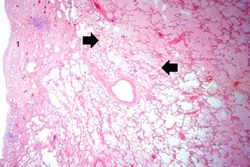 This is a higher-power photomicrograph of lung. The edema fluid within the alveoli is visible at this higher magnification (arrows). The thickened pleura (1) is on the left.
 -
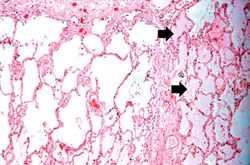 This is a higher-power photomicrograph showing edema-filled alveoli in the right portion of this section (arrows).
 -
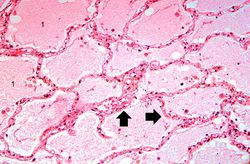 This high-power photomicrograph illustrates the edema fluid within the alveoli (1) and the congestion (RBCs) in the alveolar capillaries (arrows).


Study Questions
- Define the following:
| |||||