IPLab:Lab 8:Poliomyelitis: Difference between revisions
Jump to navigation
Jump to search
No edit summary |
Seung Park (talk | contribs) No edit summary |
||
| Line 15: | Line 15: | ||
File:IPLab8Polio5.jpg|This is another high-power photomicrograph of the anterior horn with inflammatory cell infiltrate and total loss of neurons. | File:IPLab8Polio5.jpg|This is another high-power photomicrograph of the anterior horn with inflammatory cell infiltrate and total loss of neurons. | ||
</gallery> | </gallery> | ||
== Study Questions == | |||
* <spoiler text="How does poliovirus cause cell death?">Poliovirus replicates inside neurons and causes lysis of the cell.</spoiler> | |||
* <spoiler text="What is the mode of transmission of poliovirus?">Poliovirus is an enterovirus that is usually acquired from contaminated water. It has been effectively controlled by immunization; however, among the nonimmune it causes a nonspecific gastroenteritis. In a small fraction of the vulnerable population, it can invade the nervous system where it attacks lower motor neurons.</spoiler> | |||
{{IPLab 8}} | {{IPLab 8}} | ||
[[Category: IPLab:Lab 8]] | [[Category: IPLab:Lab 8]] | ||
Revision as of 10:48, 21 August 2013
Clinical Summary
Six days before his death, this 31-year-old white male became acutely ill with fever followed by an ascending paralysis which began in his feet. Three days later he was hospitalized because of difficulty in breathing. A lumbar puncture was performed and the patient's spinal fluid contained increased protein and polymorphonuclear leukocytes (4.30 PMNs/cmm). He died on the third hospital day.
Autopsy Findings
At autopsy, the thoracic and lumbar portions of the spinal cord were softer than normal and focally hemorrhagic.
Images
-
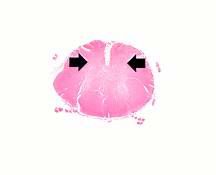 This is a low-power photomicrograph of a section of spinal cord from this case. Note that the anterior horns (arrows) are almost completely devoid of neurons.
 -
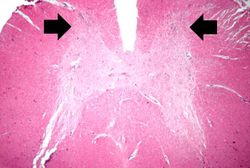 This is a higher-power photomicrograph of spinal cord from this case. Note the absence of motor neurons in the anterior horns and the gliosis (arrows).
 -
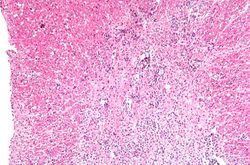 This is a high-power photomicrograph of the anterior horn of the spinal cord from this case. Note the absence of motor neurons and the diffuse gliosis.
 -
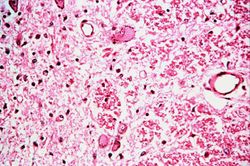 This is a higher-power photomicrograph taken at the junction of the white and gray matter. Note the inflammatory cellular infiltrate and tissue breakdown. There is significant loss of neurons and myelin in this area.
 -
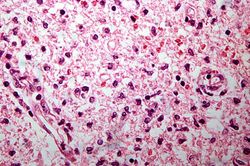 This is another high-power photomicrograph of the anterior horn with inflammatory cell infiltrate and total loss of neurons.


Study Questions
| |||||