IPLab:Lab 3:Brain Infarction
Clinical Summary
Eight years prior to his demise, this 48-year-old black male had a dissecting aortic aneurysm. The first portion of the aortic arch was dilated and he had associated aortic valve insufficiency. The defect was repaired and a mechanical prosthetic aortic valve was implanted. One year prior to his terminal admission, the patient experienced a catastrophic cerebrovascular accident (CVA) with left hemiparesis and obtundation. The patient experienced severe neurologic sequelae from this CVA and was eventually transferred to a nursing home where he was bedbound and required an indwelling urinary catheter. Four months later the patient developed a urinary tract infection and was transferred to the hospital. The patient's condition deteriorated with a urinary tract infection and pneumonia and he died of sepsis.
Autopsy showed the expected findings in the aorta and in a 760-gram heart. The mechanical valve showed some old thrombotic material adherent to the valve which was probably the source of the emboli which caused the patient's CVA. The patient's 1250-gram brain showed extensive old infarctions in at least three different areas, with the largest (12.5 x 5.5 cm) in the distribution of the right middle cerebral artery.
Images
-
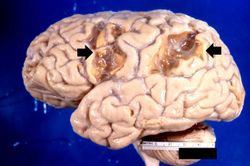 This is a gross photograph of the brain which contains two areas of infarction (arrows).
 -
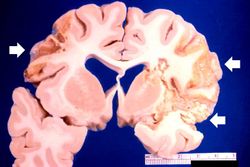 This is a gross photograph of a cross-section of brain demonstrating the areas of infarction (arrows).
 -
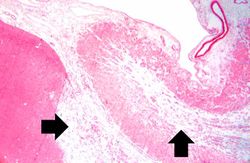 This is a low-power photomicrograph of brain at the edge of the infarct. Note the loss of brain parenchyma (arrows).
 -
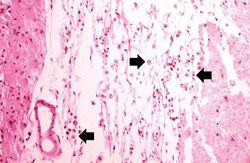
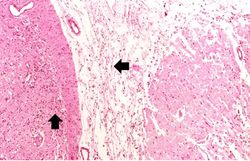 This is a photomicrograph of the edge of the infarct. Note the numerous inflammatory cells in the brain parenchyma and adjacent to the remaining brain tissue (arrows).
 -
 This is a higher-power photomicrograph of the previous image showing that the inflammatory cells (arrows) are primarily macrophages and microglia which have phagocytosed the dead brain tissue.
 -
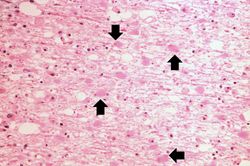 This is a photomicrograph of brain tissue adjacent to the area of infarction. There are numerous activated gemistocytic astrocytes (arrows).
 -
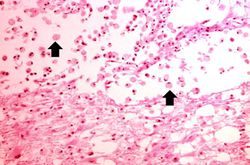 This is a photomicrograph of the edge of the infarct. The macrophages that are full of brain tissue (“gitter cells”) are at the top of the image (arrows) and the brain parenchyma containing gemistocytic astrocytes is at the bottom.
 -
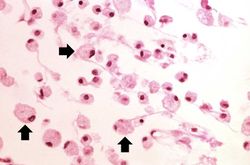 This is a high-power photomicrograph of gitter cells (arrows).
 -
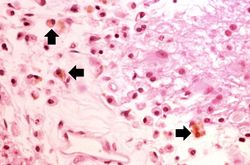 This is a photomicrograph of the edge of the infarct. Note the gitter cells, gemistocytic astrocytes, and some hemosiderin-laden macrophages (arrows).
 -
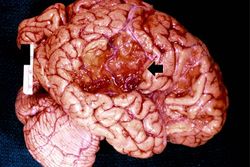 This is a gross photograph of a brain from another patient with an old healed infarct. Note the meninges overlying the infarcted region (arrow).
 -
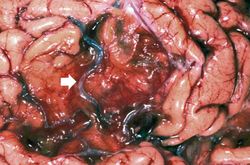 This is a closer view of the brain demonstrating an old healed infarct with the meninges containing blood vessels (arrow) overlying the infarcted region.


Study Questions
- <spoiler text="What is the most common cause of stroke?">Thrombotic occlusion of cerebral arteries due to atherosclerosis. The carotid arteries, the origin of the middle cerebral artery, and either end of the basilar artery are the most common sites of thrombus.</spoiler>
- <spoiler text="What is the likely cause of stroke in this patient?">Infarction resulting from thrombotic material from the prosthetic heart valve.</spoiler>
Additional Resources
Reference
- eMedicine Medical Library: Ischemic Stroke
- eMedicine Medical Library: Acute Aortic Dissection
- eMedicine Medical Library: Prosthetic Heart Valves
- Merck Manual: Overview of Stroke (CVA)
- Merck Manual: Thrombotic Disorders
- Merck Manual: Aortic Dissection
Journal Articles
- Love S, Barber R, Wilcock GK. Neuronal death in brain infarcts in man. Neuropathol Appl Neurobiol 2000 Feb;26(1):55-66.